
Mental Topogrpahy
An exploration of the mind as terrain: layered, volatile, restrained, and precise all at once. These works translate internal chaos into composed visual language, where color becomes emotion, texture becomes memory and form becomes thought.
Rather than depicting physical landscapes, this collection maps the psychological ones. Each piece captures the moments of tension and release, order emerging from disorder, and beauty found within complexity. Colors collide, recede and harmonize. These elements mirror the way the mind oscillates between clarity and overwhelm.
The work is intentionally abstract yet deeply personal. Through controlled chaos, the viewer is invited to project their own experiences onto the surface. There is no fixed interpretation just recognition.
Mental Topography is for the intellectually curious and emotionally fluent. It honors the sophistication of the inner world, positioning chaos not to be corrected but something to be refined, understood and ultimately elevated.
Current Pieces
Below are pieces currently part of the Mental Topography collection

Where Color Settles
2026 | Mixed Media Relief on Canvas | 24 × 24 in
Layered blocks of pigment accumulate through repetition and restraint. Each pass of color presses against the next, building a surface shaped by weight, rhythm, and intentional pause. Movement is present, but contained — slowed until saturation finds equilibrium.
This work reflects the moment after motion, when energy no longer pushes forward but rests within form. Color settles not as stillness, but as resolution.

Emerald Circuit
2026 | Acrylic on Canvas | 30 × 40 in
A closed system charged with energy, repetition, and pressure. Linear pathways suggest movement without escape, while color pulses hint at internal activation.
This work reflects the mental loop — momentum without resolution, motion without rest.

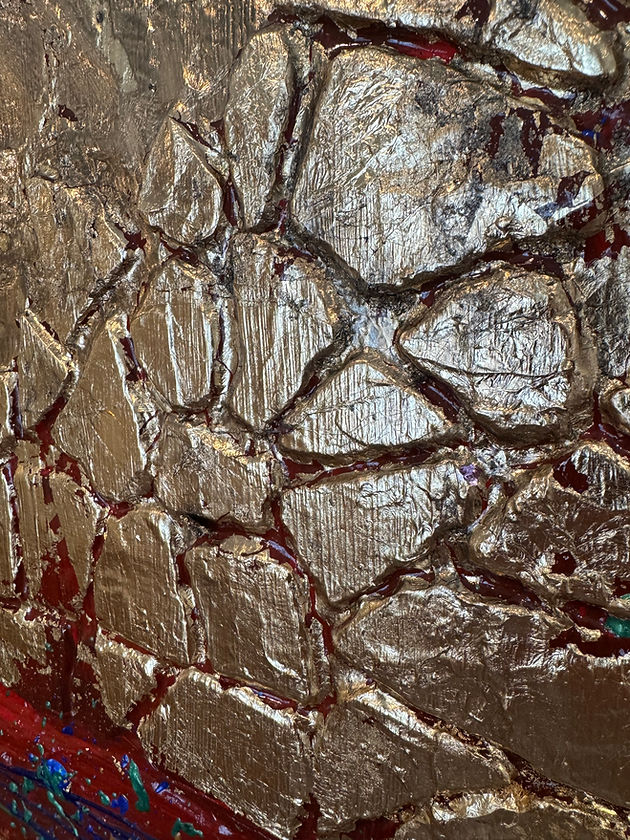
Gilded Fault Lines
2026 | Mixed Media on Canvas | 30 × 40 in
Beneath polished surfaces, fractures remain visible. Metallic accents trace points of tension, emphasizing breaks rather than hiding them.
This piece examines how value, beauty, and damage often coexist — and how fracture can become part of the structure itself.